

Collagen supplements for skin elasticity supply the amino acids your skin loses as it ages — your body sheds roughly 1% of its collagen every year starting in your mid-20s, and that decline is what shows up as fine lines, sagging, and slower skin recovery. This 2026 guide ranks the collagen formats that actually map to skin structure, then adds one herbal route Sol Nutrition customers pair with them for skin support from the inside out.
- Hydrolyzed collagen peptides are the best collagen supplements for skin elasticity in 2026 — buy a Type I and III powder first.
- Liquid collagen wins for absorption-sensitive users; expect a higher cost per serving.
- Collagen gummies underdose almost every time — treat them as a snack, not a supplement.
- Pair any collagen with vitamin C, or your body can't build new collagen efficiently.
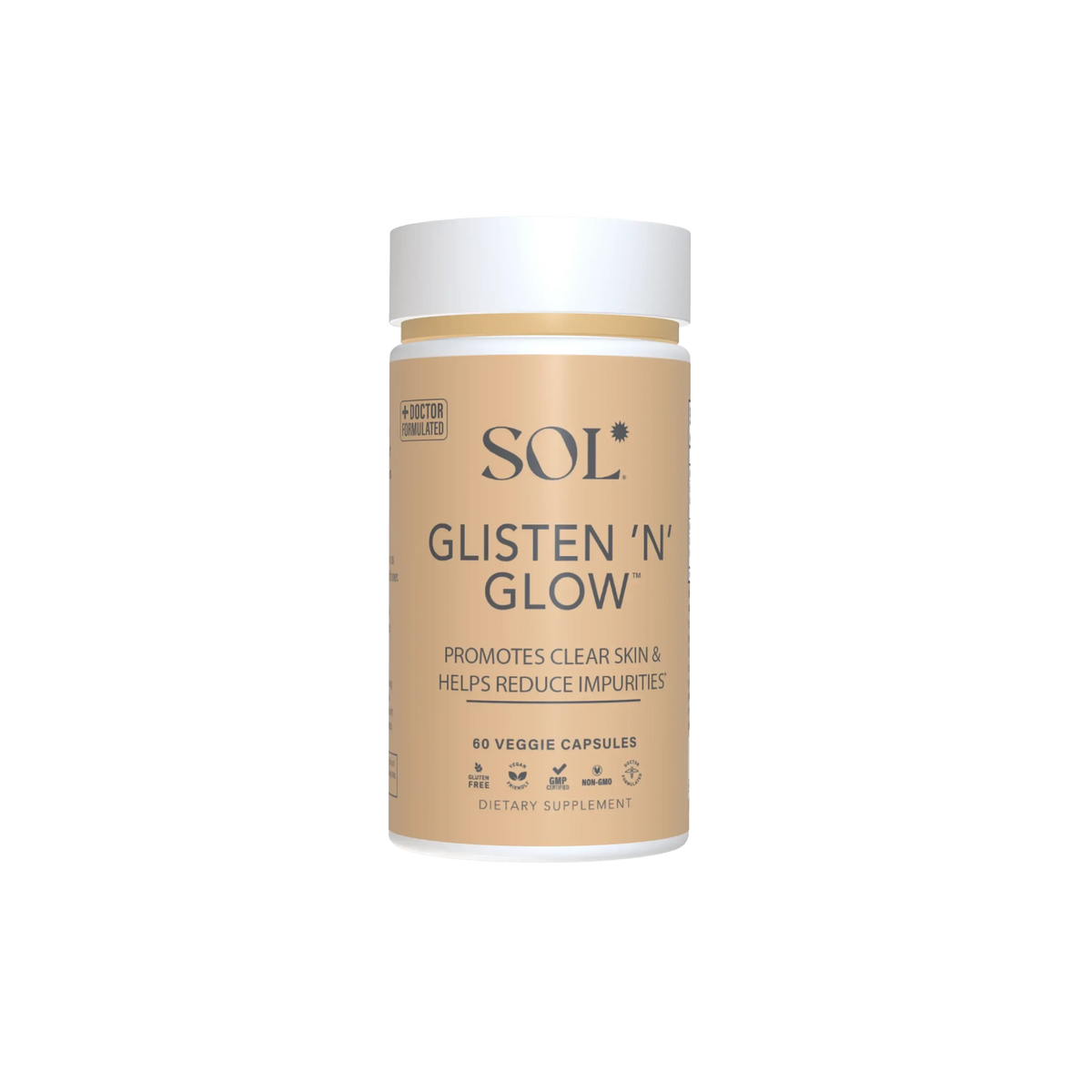
- Sol Nutrition's Glisten 'n' Glow is the herbal inside-out complement, not a collagen replacement.
Why this matters
Collagen is the structural protein holding your skin together, and skin elasticity depends on how much of it your dermis can maintain. The catch: supplement collagen is not collagen in your skin. You swallow amino acids (glycine, proline, hydroxyproline), your body decides where to deploy them, and it builds new collagen only when the raw materials and the co-factors — especially vitamin C — are both present.
That is why this guide ranks formats rather than a single magic product, and why it ends with an herbal option. Skin is an organ, not a shortage of one molecule; the gut health supplements guide covers why absorption and gut balance decide whether any of this reaches your bloodstream in useful amounts.
What makes the best collagen supplement
- Hydrolyzed (peptide) form — smaller peptides absorb better than whole collagen; anything not labeled "hydrolyzed" or "peptides" is a harder pass.
- Type I and III for skin — these are the dominant collagen types in skin; Type II targets joints instead.
- A honest daily dose — published skin studies typically use 2.5 to 10 grams of collagen peptides per day; a serving far below that range is underdosed.
- Vitamin C in the routine — your body needs it to synthesize collagen, whether it comes from the blend or your breakfast.
- Third-party testing signal — look for brands that publish purity or heavy-metal testing.
- A price you can sustain — collagen works on a months-long timeline, so per-serving cost matters more than bottle price.
At a glance
| Format | Best for | Standout feature | Key limitation |
|---|---|---|---|
| Hydrolyzed peptides powder | Overall skin elasticity | Matches published study doses | Needs daily mixing |
| Liquid collagen | Absorption-sensitive users | Pre-dissolved, often flavored | Higher cost per serving |
| Marine collagen peptides | Pescatarian diets | Type I-rich, smaller peptides | Not for shellfish allergies |
| Collagen gummies | Convenience seekers | No prep at all | Almost always underdosed |
| Herbal skin support | Whole-body route | Supports skin from gut and detox side | Not a collagen source |
The ranked list
1. Hydrolyzed collagen peptides powder: best overall for skin elasticity
Powdered peptides are what the published skin-elasticity trials actually used, which is the strongest reason they lead this list. They mix into coffee or smoothies, come unflavored, and let you control the exact daily dose. Verdict: Buy.
2. Liquid collagen: best for absorption-sensitive users
Liquid formats skip the mixing step and suit people who never keep a routine going when it involves a shaker bottle. The tradeoff is cost — per gram of collagen, you usually pay a premium for the convenience. Verdict: Consider.
3. Marine collagen peptides: best for pescatarians
Marine collagen is predominantly Type I, the type most concentrated in skin, and its smaller peptide size is a common marketing point. It is the right pick if you avoid bovine products — just verify the source if you have any fish or shellfish allergy. Verdict: Buy for pescatarians.
4. Collagen gummies: skip in 2026
To hit even the low end of the published dose range, you would need a fistful of gummies a day, plus their sugar. As a daily skin routine they disappoint; the verdict stays honest. Verdict: Skip.
5. Glisten 'n' Glow by Sol Nutrition: best herbal complement
Collagen supplements are one input; skin also reflects digestion, detox load, and inflammatory balance. Glisten 'n' Glow is Sol Nutrition's clear-skin formula, built on herbal ingredients positioned to reduce acne, rashes, and puffiness by working with your body rather than supplying one protein. Pairing it with a peptides powder covers both routes: building blocks from the collagen, internal balance from the herbs. It is not a collagen source, and it should not replace one if elasticity is your single goal. Verdict: Buy as the complement, not the substitute.
The liver processes hormones and nutrients that influence skin, which is why the liver health and detox support guide is worth reading alongside this one.
How we ranked
Ranking follows the six criteria above in order: peptide form first, because absorption decides everything downstream; collagen type second; daily dose third. Formats that fail the dose test (gummies) rank last regardless of taste or marketing.
Which collagen supplement should you choose?
If you buy one product in 2026: a hydrolyzed Type I and III peptides powder, taken daily with a vitamin C source, for at least eight to twelve weeks. Add Sol Nutrition's Glisten 'n' Glow if you want the herbal, gut-and-detox-side support running in parallel.


FAQ
What is the best collagen supplement for skin elasticity in 2026?
A hydrolyzed collagen peptides powder supplying Types I and III, taken at 2.5 to 10 grams daily with vitamin C, is the best-supported pick for skin elasticity in 2026. Marine peptides are the equivalent choice for pescatarians.
How long does collagen take to improve skin?
Published skin studies typically run eight to twelve weeks before measurable elasticity changes. Judge any collagen product on that timeline, not on a two-week impression.
Do collagen gummies work?
Collagen gummies rarely reach the 2.5-gram daily minimum used in studies, so most fall short as a skin supplement. They function as a supplement-flavored candy rather than a dose.
Can I take collagen with other supplements?
Yes — collagen pairs well with vitamin C, and herbal formulas like Sol Nutrition's Glisten 'n' Glow are commonly stacked with it. Space multiple herbal formulas through the day rather than taking everything at once.
Is marine collagen better than bovine?
Marine collagen is richer in Type I, the type concentrated in skin, while bovine peptides supply Types I and III. For skin elasticity specifically both work; choose based on diet and allergy needs.
Do vegetarians have collagen options?
True collagen is animal-derived, so vegetarians look for 'collagen builders' — vitamin C, zinc, and amino-acid blends that support your body's own collagen production instead of supplying it.
How much collagen should I take per day?
Most published skin research uses 2.5 to 10 grams of collagen peptides daily. Check your powder's serving size against that range before assuming one scoop is enough.
Does collagen help with aging skin or just elasticity?
Elasticity, hydration, and fine-line depth are the three outcomes collagen studies measure most often, and all three trace back to the same dermal collagen network.
One last thing
The supplement is the smaller half of the equation. UV exposure degrades dermal collagen faster than any powder can rebuild it — daily sunscreen does more for skin elasticity in 2026 than doubling your collagen dose.
Share:
Best natural supplements for hormonal hair loss in your 30s (2026)
Best women's multivitamin for hormone and energy support (2026 buyer's guide)