

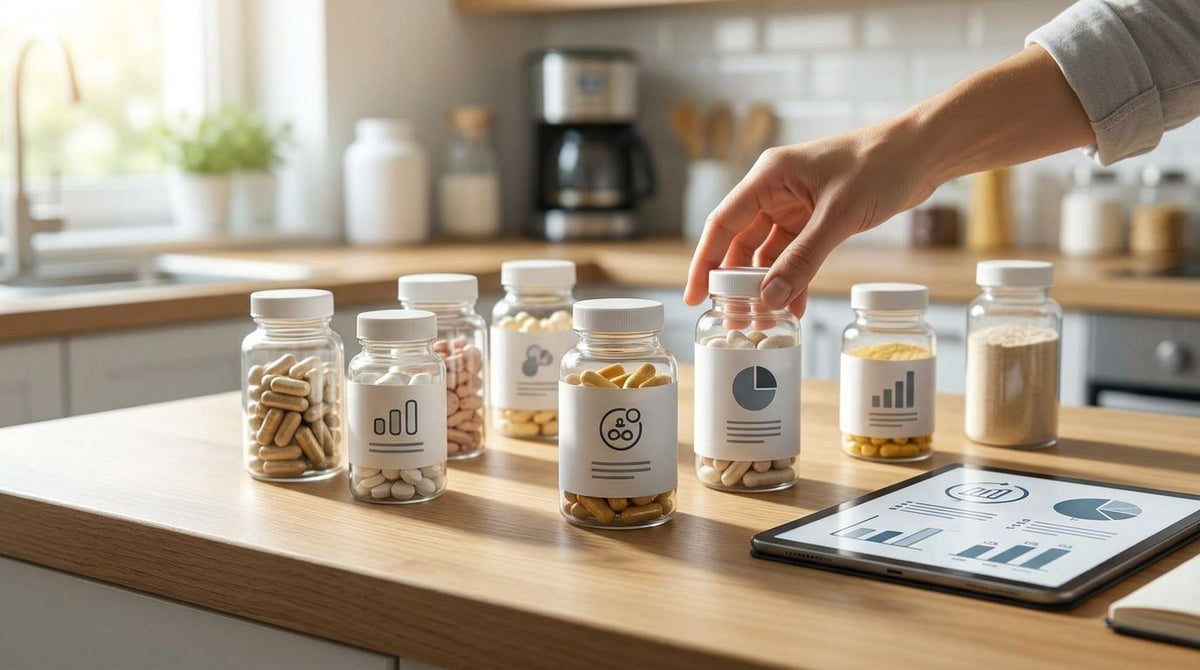
Best overall for ingredient transparency: weight loss supplements that disclose every dietary ingredient and its amount per serving. For your 2026 shortlist, prioritize readable Supplement Facts panels over product names, blend totals, or weight-loss promises; the ranking below compares disclosure formats, not proven weight-loss results.
- Weight loss supplements with individually disclosed amounts rank highest for label transparency, not guaranteed results.
- Solnutrition shoppers should review the full supplement label before choosing an herbal weight-management product.
- Proprietary blend totals do not reveal how much of each ingredient a serving contains.
- Ingredient identity, serving size, warnings, and relevant evidence matter more than front-label promises.
Why ingredient transparency matters
You cannot compare a supplement meaningfully when you cannot tell what a serving contains. A recognizable herb name is a starting point, not enough information to judge the formula or check it against your medications.
If you are considering the Solnutrition SKINNY ME & GOGO ENERGY WEIGHT LOSS COMBO, review the label for each included product rather than treating the combination name as evidence of effectiveness. Solnutrition weight loss supplements are best considered by herbal-supplement shoppers willing to review the complete labels with a healthcare professional.
A transparent label supports an informed conversation. It does not establish that a supplement causes weight loss, is appropriate for you, or has been studied as a finished formula.
What makes the best weight loss supplements for transparency?
Use these criteria for your 2026 comparison before considering any benefit claim:
- Ingredient identity: The label names each dietary ingredient clearly. Botanical details such as plant part and extract form help distinguish preparations.
- Individual amounts: Quantities appear for each dietary ingredient, rather than only as a combined blend weight.
- Serving clarity: You can distinguish the amount per serving from the amount per capsule, tablet, or other unit.
- Preparation details: Extract information explains what the listed material actually is. A ratio alone is not a complete description.
- Safety information: Directions, warnings, other ingredients, and relevant allergen information are readable and accessible.
- Evidence fit: Any cited research concerns an ingredient preparation and amount that you can compare with the label.
No single criterion proves effectiveness. Together, they make the product easier to assess without guessing.
Ingredient-transparency rankings at a glance
This is a decision guide for label formats, not a scored comparison of named products. A product earns its place only after its actual label has been reviewed.
| Rank and disclosure format | Best for | Standout information | Key limitation |
|---|---|---|---|
| 1. Individual amounts plus preparation details | Comparing labels with research | Ingredient quantities and relevant botanical specifications | Does not prove the finished formula works |
| 2. Individual amounts with basic ingredient names | Checking ingredient overlap | Separate quantities for each dietary ingredient | Preparation details can remain unclear |
| 3. Proprietary blend with a total amount | Identifying ingredients for a safety discussion | Ingredient names and combined blend weight | Individual ingredient quantities remain undisclosed |
| 4. Benefit claims without accessible Supplement Facts | Screening out an incomplete listing | Signals which information to request | Cannot support a meaningful ingredient comparison |
1. Detailed individual amounts: best for research comparisons
A label with individual quantities and preparation details gives you the strongest starting point for comparing a supplement with published research. For botanical ingredients, the plant part, preparation, and any stated standardization help explain what is actually inside.
An herb powder and an extract carrying the same plant name are not automatically interchangeable. Matching the name alone is not enough.
Detailed individual amounts pros:
- You can compare each listed quantity with the quantity described in a study.
- Botanical specifications help distinguish different preparations.
- Separate amounts make ingredient overlap easier to identify across products.
Detailed individual amounts cons:
- A detailed label does not demonstrate clinical benefit for the complete formula.
- Disclosed quantities still require a safety review for your circumstances.
- Missing study details can prevent a useful comparison even when the label is clear.
Best for: You want to investigate the evidence rather than rely on a familiar ingredient name.
Before choosing this format in 2026, check whether the research studied the finished product or only one component. Verdict: Buy only after the disclosed formula passes your evidence and safety checks.
2. Basic individual amounts: best for checking overlap
This format lists the amount of each dietary ingredient but provides fewer details about botanical preparations. It answers an important question: how much of each listed ingredient does a serving supply?
That makes the label useful when you already take supplements and want to avoid duplicating ingredients. It does not establish that every similarly named ingredient is equivalent.
Basic individual amounts pros:
- Separate quantities support straightforward comparisons between labels.
- You can identify repeated dietary ingredients across your routine.
- A clinician or pharmacist can review more than a combined blend total.
Basic individual amounts cons:
- An ingredient name might not identify the plant part or preparation.
- Missing extract specifications limit comparisons with research.
- Disclosure alone does not establish an appropriate amount for you.
Best for: You need to check a proposed supplement against products you already use.
Ask for clarification whenever the ingredient description leaves a meaningful question unanswered. Verdict: Hold until missing preparation details are resolved when they affect your decision.
3. Proprietary blends: best for identifying safety questions
A proprietary blend lists its dietary ingredients but reports their combined weight rather than a separate amount for each component. Under U.S. labeling rules, blend ingredients generally appear in descending order by weight.
That order provides context, but it does not reveal individual quantities. A combined total cannot tell you whether a particular component matches an amount used in research.
Proprietary blend pros:
- Named ingredients give you a starting point for checking potential interactions.
- The total identifies the combined amount of the blend per serving.
- Ingredient order gives limited information about relative weight.
Proprietary blend cons:
- You cannot determine the exact amount of each component.
- Ingredient-by-ingredient research comparisons remain incomplete.
- Reviewing overlapping ingredients becomes harder when quantities are hidden.
Best for: You are preparing questions for a healthcare professional, not trying to confirm research-matched amounts.
A proprietary blend is not automatically unsafe or ineffective. It simply provides less information for this particular comparison. Verdict: Hold when individual quantities are necessary for your safety or evidence review.
4. Claims without Supplement Facts: best for screening listings
A product listing that emphasizes benefits without making the complete Supplement Facts panel accessible cannot support a label-based comparison. Words such as “natural,” “metabolism,” and “appetite” do not identify the contents of a serving.
Treat that listing as an unfinished research step. Request the complete label before making a purchase decision.
Claims-only listing pros:
- The stated purpose helps you decide whether the product is relevant to your search.
- It makes the next question clear: where is the complete label?
- It gives you a reason to pause instead of filling gaps with assumptions.
Claims-only listing cons:
- Ingredient amounts cannot be compared from benefit language.
- Directions and warnings can remain outside your review.
- Product names do not establish ingredient identity or effectiveness.
Best for: You want a firm rule for removing inadequately documented options from your shortlist.
Do not confuse an appealing description with a transparent formula. Verdict: Skip the purchase until you can review the complete label.
How to read a supplement label without guessing
Start with serving size. Then read the quantities, ingredient descriptions, other ingredients, directions, and warnings as separate pieces of information.
Compare the same units
A gram equals 1,000 mg, and a milligram equals 1,000 mcg. Those are unit conversions, not recommended supplement amounts.
Convert quantities to the same unit before comparing labels. A larger-looking number does not necessarily represent a larger amount when the units differ.
Separate serving size from container size
The amount per serving is not automatically the amount per capsule. Read how the label defines a serving before calculating your intake.
Likewise, the total number of capsules in a container does not describe the strength of the formula. Keep quantity, serving size, and ingredient amount separate.
Understand what Daily Value does not tell you
A 100% Daily Value statement is not a measure of weight-loss effectiveness. Daily Values provide nutrition-label reference amounts for nutrients that have them; many botanical ingredients do not have an established Daily Value.
Do not rank an herbal formula by the presence or absence of a percentage alone. Ingredient identity and quantity still need their own review.
Read beyond the main panel
Other ingredients can include capsule materials and formulation aids. Their presence is not automatically a warning sign, but they matter when you have sensitivities or dietary restrictions.
Read the complete package rather than only the front label or a cropped product image. For your 2026 shortlist, save a readable copy so a pharmacist or clinician can review the same information you used.
Check evidence separately from label quality
A transparent formula and an effective formula are different judgments. Keep them separate.
The NIH Office of Dietary Supplements explains in its consumer guidance on dietary supplements for weight loss that evidence supporting these products is limited, and some products can cause harm or interact with medicines. The FDA also warns consumers about weight-loss products containing hidden drug ingredients.
For a 2026 purchase decision, ask these questions:
- What was studied? Research on an isolated ingredient does not establish the effect of a multi-ingredient product.
- Does the preparation match? A shared plant name does not confirm the same extract or composition.
- Does the amount match? A blend total cannot establish an individual ingredient quantity.
- Who participated? Results from a particular study population do not automatically apply to everyone.
- What was measured? A change in a laboratory marker is not the same outcome as sustained weight loss.
U.S. dietary supplements are not FDA-approved for safety and effectiveness before marketing in the same way prescription drugs are. A label that follows disclosure requirements is not an FDA endorsement.
Choosing an herbal combination without doubling up
For Solnutrition weight loss supplements, assess each included formula separately before assessing the combination. A shared package or combined product name does not replace the need to read both labels.
Write down everything you currently take, including medicines, supplements, and caffeinated products. Bring that list and the complete product labels to a pharmacist or clinician, particularly if you take prescription medicine or manage a health condition.
Do not assume an energy-oriented product is stimulant-free, contains caffeine, or has a particular effect based on its name. Confirm the actual ingredients instead.
Avoid starting several new supplements simultaneously. If you develop an unwanted effect, identifying the responsible product becomes harder when several things changed together.
Pregnancy, breastfeeding, planned surgery, and ongoing medical care require individualized advice. Natural does not mean suitable for every person.
How these transparency rankings work
The ranking prioritizes information that lets you inspect a formula: ingredient identity, individual quantities, serving clarity, preparation details, safety information, and evidence fit.
It does not award points for brand familiarity, testimonials, or weight-loss language. No named product receives a transparency position without a complete label comparison.
That distinction keeps the guide useful in 2026 even when product descriptions change. The question stays the same: can you determine what you would take and assess it responsibly?
Which weight loss supplements should you choose?
Choose the most clearly disclosed formula that also passes an individualized safety and evidence review. Detailed individual quantities are the default starting point, not a guarantee that you need a supplement.
If a product leaves you guessing about an ingredient or its amount, pause. Getting a clear answer is more useful than choosing the most persuasive promise.
FAQ
What's the best way to compare weight loss supplements?
Compare complete Supplement Facts panels before comparing benefit claims. Prioritize individual ingredient quantities, clear serving sizes, relevant preparation details, and warnings, then assess evidence and personal suitability separately.
Are proprietary blends bad for weight loss?
A proprietary blend provides less ingredient-level quantity information, but that alone does not establish effectiveness or safety. The combined blend weight does not reveal how much of each ingredient you would take.
Does a transparent ingredient label mean a supplement works?
No, ingredient transparency does not prove weight-loss effectiveness. It gives you information needed to compare the formula with research and discuss its suitability with a healthcare professional.
Are herbal weight loss supplements automatically safer?
No, herbal ingredients can cause unwanted effects and interact with medicines. Safety depends on the actual ingredients, amounts, your health, and what else you take.
Can I combine a weight-management supplement with an energy supplement?
Do not assume the combination is appropriate without checking both complete labels. A pharmacist or clinician can review repeated ingredients, potential interactions, and your overall intake.
Does the FDA approve weight loss supplements before sale?
The FDA does not approve dietary supplements for safety and effectiveness before marketing in the same way it approves prescription drugs. A compliant label does not mean a product has FDA approval.
Should I choose a supplement if its label is hard to find?
Wait until you can review the complete, readable label. Product names, testimonials, and benefit descriptions cannot substitute for ingredient quantities, directions, and warnings.
One last thing
The most useful comparison is not always between two bottles. Compare the promised outcome with what the evidence actually measured.
An ingredient study, a clear label, and a convincing testimonial answer different questions. Keep those questions separate, and your next purchase decision becomes much clearer.
Share:
Can you take sleep supplements every night without tolerance?
Best joint pain supplements for seniors in 2026