

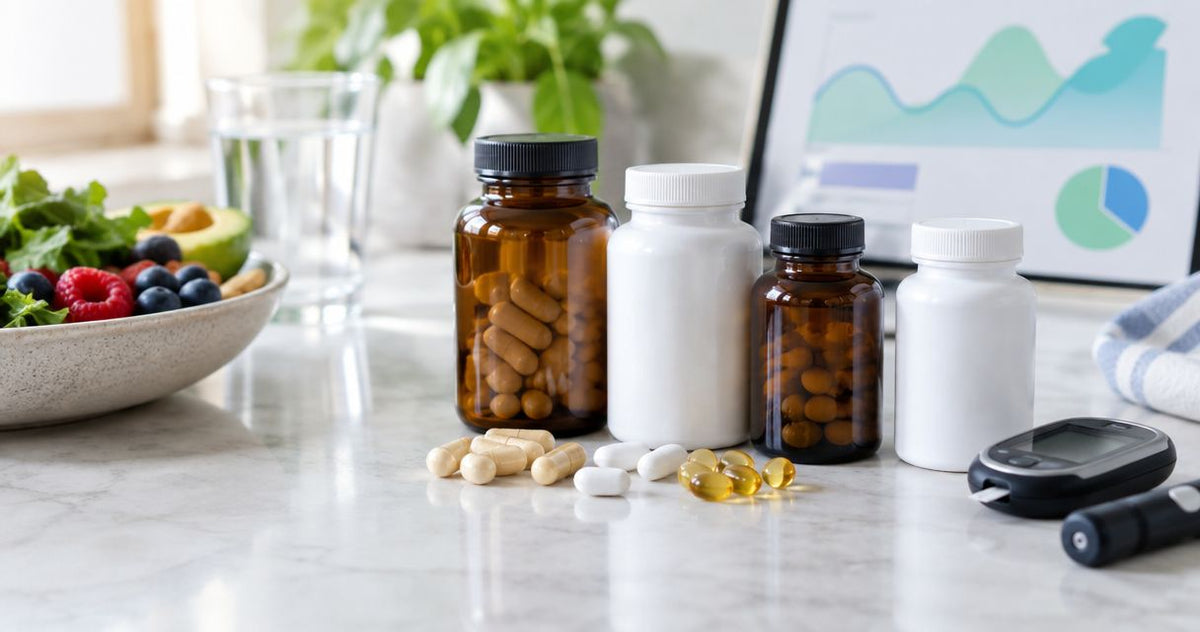
Best overall adjunct to discuss: psyllium. Best herbal research candidate: berberine. Best targeted option: magnesium for a confirmed deficiency. This 2026 guide ranks blood sugar supplements by the usefulness of their human evidence, their limitations, and the safety questions you should answer before buying.
- Psyllium ranks first among these blood sugar supplements as a fiber-based adjunct, not a diabetes treatment replacement.
- Berberine has human research, but interactions and inconsistent study quality limit confidence.
- Magnesium belongs in a deficiency discussion, not a universal blood sugar support routine.
- Solnutrition Sugar Down requires a separate formula review; ingredient research cannot establish finished-product effectiveness.
Why this matters
Blood sugar supplements sit between two very different promises: supporting everyday wellness and treating a medical condition. A supplement label is not evidence that a product prevents diabetes or replaces prescribed treatment.
If you are considering Solnutrition's Sugar Down™, review its current label with your pharmacist or clinician before adding it to your routine. Its stated focus is healthy blood sugar and metabolic support; that positioning does not establish clinical effectiveness.
For this 2026 ranking, the central question is practical: does the research match your health situation, and does it justify the risks? The American Diabetes Association's Standards of Care in Diabetes, 2026 does not recommend routine vitamin, mineral, or herbal supplementation for glycemic benefits in people without an underlying deficiency.
What makes the best blood sugar supplements?
A useful comparison starts with evidence, not the strongest-sounding label. These five criteria determine the order below:
- Human outcomes: Prioritize controlled human studies measuring glucose or HbA1c, not laboratory mechanisms alone.
- Study consistency: Look for findings that hold across studies rather than one unusually positive result.
- Population match: Results in adults with diabetes do not automatically apply to people with normal glucose.
- Formula match: The studied ingredient, preparation, and amount must match the product being considered.
- Safety fit: Medication interactions, swallowing concerns, pregnancy, and kidney or liver conditions can outweigh a possible benefit.
Blood sugar supplements at a glance
This is a decision ranking, not a head-to-head trial result. A higher position means a more useful starting point for the stated situation, not proof of a larger glucose reduction.
| Rank | Option | Best for | Evidence or practical strength | Key limitation |
|---|---|---|---|---|
| 1 | Psyllium | A fiber-focused adjunct discussion | Human trials support glycemic effects in some populations | Requires water and careful medication timing |
| 2 | Berberine | Reviewing an herbal research candidate | Human trials report glucose-related benefits | Study quality and interactions limit confidence |
| 3 | Magnesium | Addressing confirmed deficiency | Clear nutritional role when intake or status is inadequate | Not a general glucose treatment |
| 4 | Cinnamon | Separating food use from extract claims | Human research exists | Results and preparations are inconsistent |
| 5 | Chromium | Evaluating a heavily marketed mineral | Studied for glucose metabolism | Routine benefit is not established |
| Unranked | Sugar Down™ | Reviewing a specific herbal formula | Product-specific label discussion | Finished-product efficacy cannot be inferred |
1. Psyllium: best blood sugar supplement for a fiber-first approach
Psyllium is a gel-forming soluble fiber. Human research supports improvements in some glucose measures, particularly in people with impaired glucose control, but the findings do not make psyllium a substitute for diabetes care.
It takes the first position because it offers a clear, food-related role that you can discuss alongside your overall fiber intake. That is a narrower recommendation than calling it the strongest glucose-lowering supplement.
Psyllium pros:
- Controlled human studies have examined glucose outcomes.
- Its fiber role fits a broader nutrition plan.
- Regularity is another established use, separate from glucose support.
Psyllium cons:
- It can cause bloating or changes in bowel habits.
- It requires adequate liquid and can affect medication timing.
Best for: Adults discussing a fiber supplement as an adjunct to nutrition and medical care.
MedlinePlus directs users of psyllium powder or granules to mix them with at least 8 ounces of liquid. Follow the specific label and ask a pharmacist about spacing it from medicines; swallowing difficulty or suspected bowel obstruction needs medical advice first.
Verdict: Buy only if a fiber supplement fits your clinician-reviewed plan.
2. Berberine: best herbal option for an evidence-focused discussion
Berberine is a plant-derived compound studied for blood glucose and other metabolic outcomes. Trials report potential benefits, but differences in study design, preparations, and background treatment make broad promises unreliable.
The National Center for Complementary and Integrative Health identifies limitations in the diabetes supplement evidence. Berberine deserves discussion, not the label “natural metformin”: a supplement is not interchangeable with a prescription medicine.
Berberine pros:
- Human studies measure glucose-related outcomes.
- Research includes adults with metabolic conditions.
- A single-ingredient label makes comparison with a study easier than an undisclosed blend.
Berberine cons:
- Digestive side effects and drug interactions require attention.
- Pregnancy, breastfeeding, and infant exposure raise safety concerns.
Best for: Adults who want a clinician to evaluate an herbal candidate against their medication list.
In a 2026 buying decision, do not treat a paper about berberine as proof for every berberine-containing bottle. The preparation and the studied population still matter, and adding it to glucose-lowering medication requires professional review.
Verdict: Hold until a clinician or pharmacist reviews interactions and suitability.
3. Magnesium: best targeted option for confirmed deficiency
Magnesium is an essential mineral involved in many body processes, including glucose metabolism. Correcting a deficiency is a different goal from taking extra magnesium to lower blood sugar when your magnesium status is adequate.
The NIH Office of Dietary Supplements describes the relationship between magnesium and diabetes while noting uncertainty about supplementation as a glucose-control strategy. Start with the nutritional problem you actually have.
Magnesium pros:
- It addresses a defined nutritional need when deficiency is present.
- Food intake provides a useful starting point for assessment.
- A targeted plan avoids assuming that everyone needs supplementation.
Magnesium cons:
- Supplements commonly cause diarrhea at higher intakes.
- Kidney disease changes the safety assessment because magnesium can accumulate.
Best for: People whose clinician identifies deficiency or another clear reason for supplementation.
Bring your full supplement list to that discussion. Magnesium can already appear in multivitamins, sleep products, antacids, or laxatives, so reviewing all sources matters more than choosing a bottle with “metabolic” on the front.
Verdict: Buy for a confirmed nutritional need, not an assumed glucose benefit.
4. Cinnamon: best option for distinguishing food from supplement claims
Cinnamon studies use different species, extracts, amounts, and treatment periods. Some report changes in glucose measures, but the overall findings do not establish a dependable diabetes treatment.
Using cinnamon to flavor food is not equivalent to taking a concentrated extract. The distinction matters because exposure and safety questions change with the preparation.
Cinnamon pros:
- Human trials have investigated glucose outcomes.
- Culinary use adds flavor without requiring a supplement routine.
- Species and preparation are concrete details you can check on a label.
Cinnamon cons:
- Inconsistent study results weaken broad effectiveness claims.
- Cassia cinnamon contains coumarin, which raises liver-safety concerns with substantial exposure.
Best for: Readers deciding whether a food ingredient justifies a separate supplement purchase.
The National Center for Complementary and Integrative Health does not consider cinnamon clearly supported for treating a health condition. A favorable headline should not outweigh that uncertainty or your own liver-health considerations.
Verdict: Skip cinnamon supplements as your default blood sugar strategy.
5. Chromium: best mineral to scrutinize before buying
Chromium is marketed around insulin function and glucose metabolism. Those biological associations do not establish that routine supplementation improves blood sugar in the person reading the label.
The NIH Office of Dietary Supplements describes inconsistent findings from supplementation studies. A larger amount on the label is not evidence of a better outcome.
Chromium pros:
- Human research exists rather than relying only on laboratory theory.
- Single-ingredient products allow a direct label review.
- Its evidence provides a useful example of why a mechanism is not a clinical result.
Chromium cons:
- Routine benefit for glucose management is not established.
- Interactions and kidney or liver concerns require individual assessment.
Best for: People checking whether a mineral claim deserves a place in their routine.
Before adding chromium, check whether another supplement already contains it. Stacking products makes exposure harder to track without resolving the uncertainty about benefit.
Verdict: Skip routine chromium supplementation for blood sugar alone.
Where does Sugar Down fit?
Solnutrition Sugar Down is best suited to shoppers seeking an herbal blood sugar support formula to review with their clinician, not a replacement for diabetes treatment. It remains outside the evidence ranking because product positioning and ingredient research cannot establish finished-product results.
Solnutrition founder Dr. Jing Liu brings more than 30 years of clinical experience in Traditional Chinese Acupuncture and Herbal Medicine. That experience is a central brand distinction, but it is not a clinical trial of Sugar Down.
Sugar Down pros:
- Its stated purpose directly matches blood sugar and metabolic support shopping.
- A product-specific discussion keeps the decision focused on the actual formula.
- The founder's clinical background provides context for the brand's herbal focus.
Sugar Down cons:
- Founder experience cannot establish product efficacy.
- Suitability still depends on the current label, your medicines, and your health history.
Best for: Wellness-focused adults who want a professional review of a specific herbal formula.
For your 2026 review, ask about the full ingredient amounts, medication compatibility, and whether any cited research studied the finished formula. Do not assume Sugar Down contains any ingredient ranked above without checking its label.
Verdict: Hold until the formula and your individual safety needs are reviewed.
How this ranking works
The ranking prioritizes human evidence, practical relevance, and safety rather than customer testimonials or ingredient popularity. It draws on the ADA's Standards of Care in Diabetes, 2026, NCCIH resources on diabetes supplements and cinnamon, NIH Office of Dietary Supplements fact sheets on magnesium and chromium, and MedlinePlus psyllium guidance.
These sources address different questions: clinical recommendations, evidence uncertainty, nutrient safety, and administration. The order is an editorial decision framework, not proof that one option outperforms another in a direct trial.
Which blood sugar supplement should you choose?
Start with your diagnosis and care plan, not a supplement stack. If you want a fiber-focused adjunct, psyllium is the first discussion on this list; if deficiency is the issue, magnesium belongs in a targeted nutritional plan.
For a useful appointment, bring:
- Your current medicines and supplements.
- Recent glucose or HbA1c results, if available.
- The exact product label you are considering.
- A clear question about what outcome would justify continued use.
HbA1c reflects average blood glucose over roughly 2 to 3 months, according to the National Institute of Diabetes and Digestive and Kidney Diseases. Feeling more energetic after a few days does not establish an improvement in that measure.
FAQ
What's the best blood sugar supplement in 2026?
There is no universally best blood sugar supplement. Psyllium is the first adjunct to discuss in this guide for a fiber-focused approach, while medical treatment and nutrition remain the foundation for diagnosed glucose problems.
Is berberine better than metformin?
Berberine is not an interchangeable substitute for metformin. Research on a supplement does not establish equivalent effectiveness, safety, or product consistency, so do not stop prescribed treatment to try it.
Can blood sugar supplements prevent diabetes?
Blood sugar supplements are not established substitutes for evidence-based diabetes prevention. If you have prediabetes, ask about structured lifestyle support and whether medication is appropriate for your individual risk.
Can I take a supplement with diabetes medication?
You need a clinician or pharmacist to review the exact combination first. Some supplements can add to glucose-lowering effects or interact with medicines, and your monitoring plan may need adjustment.
Does Sugar Down have clinical proof?
A clinical-effectiveness claim requires research on Sugar Down itself. Ingredient studies and Dr. Jing Liu's clinical experience do not establish that the finished product produces the same outcomes.
How long should I wait to judge a blood sugar supplement?
Agree on the outcome and review schedule with your clinician before starting. HbA1c reflects roughly 2 to 3 months, while individual glucose readings vary with meals, activity, illness, and medication.
What if my blood sugar gets too low?
Blood glucose below 70 mg/dL is low and requires prompt action under your diabetes care plan. Severe confusion, seizures, or inability to swallow require emergency help; do not give food or drink to someone who cannot swallow safely.
One last thing
A better-looking reading is not automatically proof that a supplement worked. For your 2026 plan, keep a record of medication changes, meals, activity, and illness alongside any new product so your clinician can interpret the pattern.
Choose a measurable goal before choosing a bottle. That single step makes the decision more useful than another round of label comparisons.
Share:
Best supplements for bloating in 2026, ranked
Detox supplements ranked by ingredient potency (2026)