

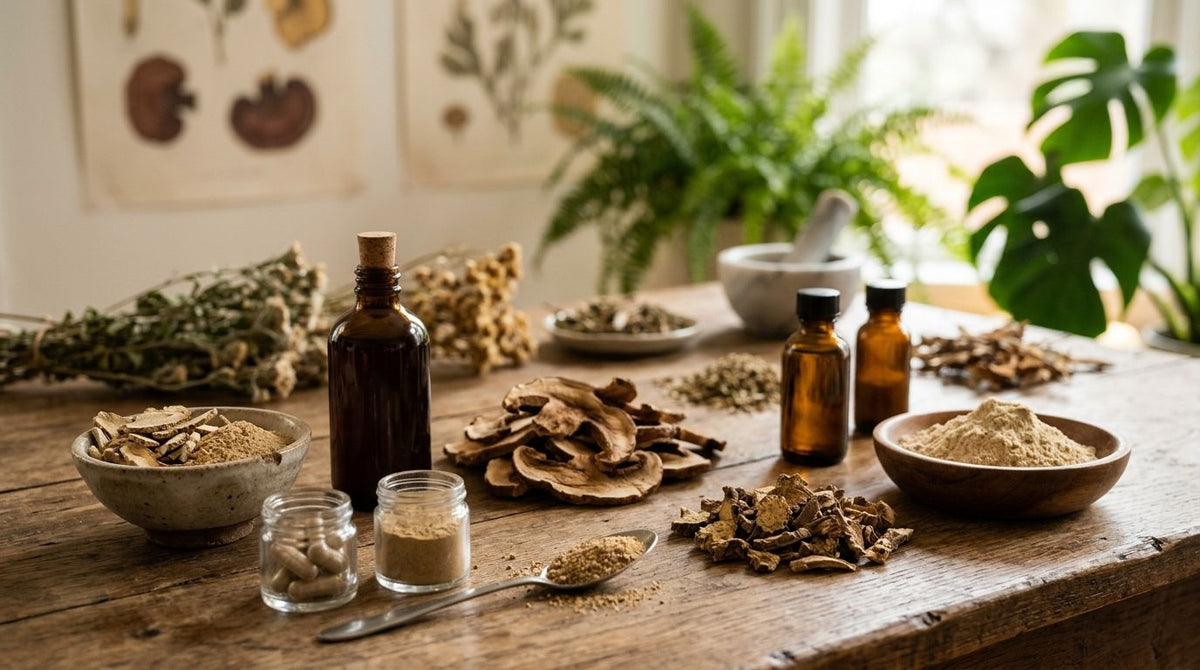
Best starting point for stress-focused research: ashwagandha. Best candidate to discuss for stress-related fatigue: rhodiola. Best option for reviewing traditional vitality use: Panax ginseng. Best reason to pause: a blend that hides individual doses. This 2026 guide ranks adaptogen supplements by how clearly you can assess their evidence, extract, and daily dose, not by an unsupported claim that one herb is universally strongest.
- Ashwagandha leads this adaptogen supplements shortlist for stress-focused research, but safety screening comes first.
- Rhodiola and Panax ginseng serve different research questions; their milligram amounts do not establish equivalent potency.
- Solnutrition shoppers should compare extract identity and daily dose before choosing herbal stress support.
- Skip potency claims that omit the plant part, extract details, or individual ingredient amounts.
Why this matters
A larger number on a bottle does not tell you whether an herbal supplement is better suited to your needs. Whole-herb powder, concentrated extract, and a multi-herb blend are different preparations. Comparing their milligram totals without those details creates a false ranking.
If you are browsing Solnutrition, the Adrenal Support product page is a relevant place to review the current label. Its name alone does not establish its ingredients, extract strength, or suitability for you.
For Solnutrition shoppers comparing adaptogen supplements, a clearly identified extract is a better starting point than a higher milligram total. That is the buying rule behind this shortlist.
Adaptogen is a broad term used for certain herbs associated with the body's response to stress. It is not a standardized potency grade, and it does not mean a supplement treats anxiety, exhaustion, or an endocrine condition.
What makes the best adaptogen supplements?
Use these criteria before comparing the options in this 2026 guide:
- Botanical identity: Look for the scientific name, not just a familiar common name. Different species are not interchangeable.
- Plant part: Root, leaf, and combined preparations require separate evaluation. A study of one preparation does not validate every other version.
- Extract description: Check whether the label identifies an extract, powder, or standardized preparation. An extraction ratio alone does not prove clinical effectiveness.
- Daily amount: Compare the full labeled daily serving with the preparation used in relevant research, rather than comparing amounts per capsule.
- Evidence fit: Match the study outcome to your goal. Stress ratings, sleep outcomes, and cognitive tests answer different questions.
- Safety fit: Consider medications, pregnancy, breastfeeding, existing conditions, and potential adverse effects before choosing an herb.
A transparent label passes the first screening step. It still needs evidence relevant to your goal and a safety check appropriate to your health.
Adaptogen supplements at a glance
This is a ranked research shortlist for 2026, not a verified product-potency leaderboard. The order starts with stress-focused evidence and then separates other reasons people consider these herbs.
| Rank and option | Best for | Standout consideration | Dose interpretation | Key limitation |
|---|---|---|---|---|
| 1. Ashwagandha | Starting a stress-focused evidence review | Human research includes stress and sleep outcomes | Match the specific extract, plant part, and daily amount | Pregnancy, thyroid concerns, medication interactions, and liver safety require attention |
| 2. Rhodiola rosea | Discussing stress-related fatigue | Studied in fatigue and stress contexts | Do not transfer a study dose to an unidentified extract | Evidence is insufficient for firm conclusions about health benefits |
| 3. Panax ginseng | Reviewing traditional vitality and cognition claims | Botanical identity separates Asian ginseng from unrelated products | Confirm species and preparation before comparing doses | Benefits are not established across broad energy claims |
| 4. Holy basil | Evaluating traditional-use claims cautiously | Also known as tulsi | No universal evidence-backed dose applies across preparations | Limited clinical evidence and incomplete safety information |
No option wins a universal potency contest. A preparation with more milligrams is not automatically more effective, and a higher concentration of a marker compound does not guarantee a better result.
1. Ashwagandha: best adaptogen for a stress-focused evidence review
Ashwagandha, or Withania somnifera, appears in human research on perceived stress and sleep. The National Center for Complementary and Integrative Health, or NCCIH, describes evidence suggesting that some preparations help with stress and insomnia, while distinguishing that from broader unproven uses.
The word some matters. Findings about a defined extract do not establish that every ashwagandha powder, gummy, or blend produces the same effects.
Ashwagandha dose context: A randomized, placebo-controlled study by Chandrasekhar and colleagues, published in the Indian Journal of Psychological Medicine in 2012, studied a particular root extract at 300 mg twice daily, totaling 600 mg per day, for 60 days in adults reporting chronic stress. These are study details, not a personal dosing recommendation or proof that another extract is equivalent.
Ashwagandha pros:
- Human studies address a clear stress-related use case.
- Defined study preparations give you something specific to compare with a label.
- Sleep research provides a separate question to discuss when poor sleep accompanies stress.
Ashwagandha cons:
- Pregnancy and breastfeeding are reasons to avoid it; thyroid and autoimmune conditions also require attention.
- Reported liver injury and medication interactions make casual self-prescribing inappropriate.
- Evidence does not establish indefinite daily use as safe.
Best for: Adults reviewing stress-focused supplement evidence with a healthcare professional.
Verdict: Hold until the extract and safety fit are confirmed.
2. Rhodiola rosea: best adaptogen candidate for discussing fatigue
Rhodiola rosea is a different herb with a different research base. Studies have examined fatigue and stress-related symptoms, but NCCIH concludes that reliable evidence is insufficient to determine whether rhodiola is useful for a health-related purpose.
That makes rhodiola a discussion candidate, not an established answer to persistent tiredness. A product described as energizing does not explain why you feel exhausted.
Rhodiola dose context: Match the botanical species, plant part, extract, and schedule to the particular study being discussed. A generic rhodiola milligram total is not enough to establish equivalence.
Rhodiola pros:
- Its fatigue-focused research asks a different question from a sleep-focused supplement.
- Single-ingredient preparations make ingredient exposure easier to identify than undisclosed blends.
- A species-specific label helps you separate the researched botanical from vague category claims.
Rhodiola cons:
- Research limitations prevent a confident benefit recommendation.
- Reported effects include insomnia, dizziness, headache, and dry mouth or excessive saliva.
- Pregnancy and breastfeeding safety information is insufficient.
Best for: People who want to discuss the limited evidence around stress-related fatigue rather than assume that all adaptogens work alike.
Verdict: Wait for a clear reason to choose it and a medication review.
3. Panax ginseng: best adaptogen for examining vitality claims
Panax ginseng, commonly called Asian ginseng, has a long history of use and has been studied for several outcomes, including cognition and fatigue. That history does not establish every modern energy or performance claim.
The species name matters here. Asian ginseng, American ginseng, and products called Siberian ginseng are not interchangeable ingredients.
Panax ginseng dose context: Identify the botanical species and preparation before comparing any serving amount. Differences in processing and ginsenoside composition prevent a simple milligram-for-milligram comparison across products.
Panax ginseng pros:
- A scientific name helps you distinguish it from other ingredients marketed as ginseng.
- Its research can be evaluated by a specific outcome rather than a broad promise of vitality.
- Clearly described preparations allow a more useful label review than an unnamed herbal complex.
Panax ginseng cons:
- Insomnia is a recognized adverse effect.
- Effects on blood sugar and potential medication interactions require screening.
- Broad claims about everyday energy exceed what you can conclude from a particular study.
Best for: Adults examining a specific ginseng claim with a pharmacist or clinician, especially when medications are involved.
Verdict: Hold unless the intended outcome and preparation are clearly identified.
4. Holy basil: best adaptogen for a cautious traditional-use review
Holy basil, also called tulsi, is commonly identified as Ocimum tenuiflorum. It appears in traditional wellness practices and modern supplements marketed around stress support.
Traditional use provides context, not proof of clinical effectiveness. Human research does not establish a universal dose or justify ranking holy basil as stronger than the other herbs here.
Holy basil dose context: Do not convert a tea serving into an extract dose or assume different preparations deliver comparable constituents. If the label leaves the preparation unclear, the potency comparison stops there.
Holy basil pros:
- The botanical name helps distinguish holy basil from ordinary culinary basil.
- Clearly stated preparation details allow you to assess what you are actually taking.
- Its traditional-use background gives you a defined claim to investigate rather than accept at face value.
Holy basil cons:
- Clinical evidence remains limited.
- Safety information is insufficient to support casual use during pregnancy or breastfeeding.
- A traditional-use claim cannot establish a safe combination with your medications.
Best for: Readers assessing traditional herbal claims without expecting a proven treatment or a standardized potency ranking.
Verdict: Wait when evidence strength is your main buying criterion.
How to compare potency and dose without getting misled
For your 2026 label review, separate these questions instead of combining them into one strength score.
What is actually in the serving?
Read the Supplement Facts panel, including the serving size. The amount per capsule and the amount per daily serving answer different questions.
An individual ingredient amount lets you assess exposure. A proprietary blend total does not reveal how much of each herb it contains.
What does the extract description establish?
Standardization identifies a specified level of a constituent or group of constituents. It does not establish that every standardized extract has equivalent effects or that a larger percentage is better.
An extraction ratio describes a relationship between starting material and extract. It is not a clinical effectiveness score.
Does the evidence match the product?
Look for a match across botanical species, plant part, preparation, daily amount, and intended outcome. If those differ, the study is background information rather than direct support for that product.
Keep study duration separate from a promise of results. The 60-day ashwagandha trial above describes how long that study ran; it does not create a deadline for you to feel better.
Is the combination appropriate for you?
Bring your complete supplement and medication list to a pharmacist or clinician. Include teas, powders, and occasional products, not just daily capsules.
Skip a blend that hides individual doses when your goal is to compare potency. You cannot make a meaningful ingredient-by-ingredient comparison from a total blend weight alone.
How this shortlist is ranked
This 2026 ranking prioritizes a relevant human research question, identifiable preparations, interpretable doses, and clear safety limitations. It does not use customer ratings, unverified product testing, or assumed ingredient lists.
The ashwagandha dose example comes from a published randomized trial with a defined preparation. NCCIH's ingredient resources provide the broader evidence and safety context for ashwagandha, rhodiola, and Asian ginseng. Neither source establishes a universal ranking across these herbs.
Solnutrition products are not assigned a potency score here because a product name cannot establish a formula's composition or clinical equivalence.
Which adaptogen supplements should you choose?
Start with the question you want answered, not the strongest-looking bottle. If stress is your focus, ashwagandha is the first research discussion in this shortlist, provided its safety restrictions do not rule it out.
If persistent fatigue is the problem, seek an assessment rather than moving automatically to rhodiola or ginseng. Supplements do not replace evaluation for sleep problems, medication effects, anemia, thyroid disease, or other causes.
For Solnutrition shoppers, the same standard applies to adaptogen supplements and other herbal formulas: confirm the current label, identify the daily amount, and check the combination before taking it. No purchase is a reasonable outcome when those questions remain unanswered.
FAQ
What's the strongest adaptogen supplement?
There is no universally strongest adaptogen supplement. Potency depends on the botanical, preparation, constituents, and dose, while usefulness depends on the outcome and the person taking it.
Is ashwagandha better than rhodiola for stress?
Ashwagandha is the stronger starting point for a stress-focused evidence discussion in this shortlist, not a proven head-to-head winner. Rhodiola has a different and less conclusive research base, and safety considerations can rule out either herb.
Is 600 mg of ashwagandha the right dose?
A 600 mg daily amount is not a universal ashwagandha recommendation. A published trial used that amount of a particular root extract, and the finding cannot be transferred automatically to other preparations or individuals.
Does a higher extract ratio mean an adaptogen works better?
A higher extract ratio does not prove better effectiveness. You still need the botanical identity, plant part, preparation details, relevant human evidence, and a safety review.
Can I take several adaptogen supplements together?
Do not assume several adaptogens are safe together. Ask a pharmacist or clinician to review the exact ingredients, individual amounts, medications, and health conditions before combining them.
Can adaptogens treat adrenal fatigue?
Adaptogens are not an established treatment for adrenal fatigue, which is not a recognized medical diagnosis. Persistent fatigue deserves assessment for recognized causes rather than an assumption that the adrenal glands need support.
Are natural adaptogen supplements safe during pregnancy?
Natural does not mean safe during pregnancy. Avoid ashwagandha during pregnancy, and ask your prenatal clinician before using other herbal supplements because safety evidence is often insufficient.
One last thing
Before choosing an adaptogen in 2026, save a photo of its current Supplement Facts panel and bring it to your medication review. That small step gives your clinician the actual preparation and serving information instead of a product nickname or a general promise of stress support.
Share:
Can weight loss supplements work without diet changes?
Can you take sleep supplements every night without tolerance?